Our 2026 Falcons read: the skill-position core is explosive enough to create fantasy ceiling if quarterback play and play calling cooperate.
Every name here was on the Falcons Week 1 roster. A roster spot is not a role, so each one still needs a current depth chart, injury report, and price before it shapes a Falcons bet or lineup.
The most common Falcons mistake is a stale take. Before you act on the Falcons, confirm the roster, find a dated depth-chart or usage report, write down the price you want, and decide what would make you pass. If one of those is missing, hold the Falcons opinion instead of dressing uncertainty as conviction.
Player names are checked against the official Falcons roster. This hub quotes no Falcons statistic; it lists what to check before you bet.
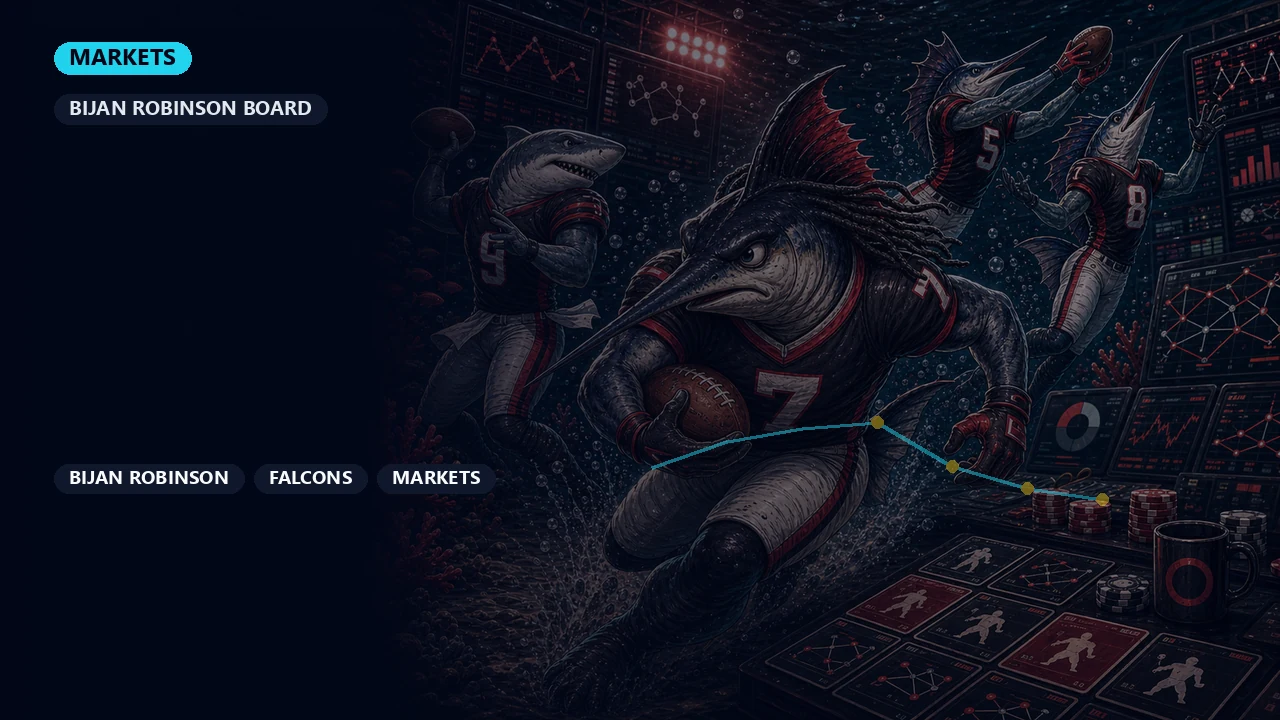
Bijan Robinson gives this preview two questions: how much work he gets and how the passing game affects that work. Keep a rushing estimate separate from a receiving estimate.
Roster names are the start of the work
The Falcons roster answers one narrow question: who is on the team. It does not tell you who starts, who handles high-value touches, who runs a full route set, or who is healthy enough to carry the Falcons role. Each of those needs its own dated source.
For Michael Penix Jr., check active status, position, depth-chart spot, and the latest injury report before building a Falcons market opinion. Do the same for Bijan Robinson. A familiar Falcons name is not an input until it is tied to the game being priced.
- Michael Penix Jr.: check the current Falcons role, the date of that report, and the game and market it applies to.
- Bijan Robinson: check the current Falcons role, the date of that report, and the game and market it applies to.
- Drake London: check the current Falcons role, the date of that report, and the game and market it applies to.
- Kyle Pitts: check the current Falcons role, the date of that report, and the game and market it applies to.
- Tua Tagovailoa: check the current Falcons role, the date of that report, and the game and market it applies to.
Do not blend four markets into one story
The skill-position core is explosive enough to create fantasy ceiling if quarterback play and play calling cooperate.
That read alone does not tell you which market to bet: a season win total, a weekly Falcons side, a team total, and a player prop each ask a different question. The Falcons evidence can overlap, but each market needs its own target and quote. A roster update that matters to a Falcons prop may already be fully priced into the side. A strong fantasy role can exist inside a poor Falcons team-total setup.
A Falcons team market needs an estimate of team outcomes, beyond a view of Michael Penix Jr..
Get the price before the story
Before taking a Falcons position, write down the available quote, the book, the time you saw it, and your fair number. Then compare like with like. If the quote changes, rerun the Falcons decision. A good Falcons read bought at the wrong price is still a bad bet.
The fair Falcons number should come from inputs available before kickoff. Final box scores, Falcons closing lines seen after the decision, and role changes learned later do not belong in it. When a Falcons report arrives late, treat your number as stale and pass rather than backfilling the answer.
Compare Falcons prices on a common basis with the vig guide and the closing-line guide.
Treat camp and practice reports with care
Falcons camp copy is cheap. A Falcons highlight, a coach compliment, or a single depth-chart rep is worth checking, but it is not a role. Repeated first-team Falcons work, a named role, and a consistent deployment pattern are stronger signals than any of that alone. Even then, the Falcons market may have moved before the evidence reached your screen.
Track quarterback usage assumptions, pass rate, and whether Bijan Robinson stays attached to every game script.
Note the report, when it was published, the player, the Falcons role being claimed, and the market after publication. Separate what a reporter saw from what someone repeated. When two credible Falcons reports disagree, keep both and lower your confidence instead of picking the one that fits your read.
Schedule context needs a real game
Rest, travel, venue, weather, and Falcons opponent familiarity can matter, but only once the game is on the schedule. "Tough stretch" is not a Falcons input. Days of rest, travel distance, surface, roof, and the forecast time are Falcons inputs when you define them before you test them.
The Falcons division games against the Buccaneers, Saints and Panthers deserve their own look. Any statement about how the Falcons perform in those games needs a stated date range, a sample size, and a scoring method that someone else could check.
Decide when you would pass before you bet
Every Falcons bet needs a failure condition. It may be a role that never materializes for the Falcons, protection that does not hold, a starting job that stays unsettled, a weather update, or a price that moves past your number. Name the condition while you are still allowed to be wrong about the Falcons.
Quarterback transition risk can affect passing props and team-total consistency.
Then make "no bet on the Falcons" a real answer. No current roster, no dated role report, no bettable quote, no matching game, and no settled model are all complete Falcons answers. They are not empty boxes to fill with an average or a recycled preseason Falcons line.
Grade the claim you actually made
Report weekly Falcons spread picks as wins and losses against the spread, with pushes separate. Include the percentage, date range, and sample size.
Keep every Falcons bet you logged, not only the ones that looked clever after kickoff. Note which model version made each call. If the roster or role picture changes, publish a new Falcons decision rather than editing the old one into hindsight.
The bet-tracking guide shows how to keep that Falcons record. The useful Falcons record is the one a second reader can rebuild from the same game, report time, quote, and rule.
The Falcons decision sequence
Before running a Falcons model, pair the current roster and injury reports with the game being priced. Record the roles for Michael Penix Jr., Bijan Robinson, and the other players above.
That process will produce fewer takes than a generic Falcons preview. Good. The point is to make the next Falcons decision easy to check and tied to a price. What to watch: the next Falcons roster or role update, paired with the first quote after it.
Team market angle
Falcons futures, win totals, division prices, team totals, and player props should all start from the same question: what has to be true about quarterback play, offensive line stability, coaching tendency, and injury luck for the price to be fair? The Falcons players who move those prices most are Michael Penix Jr., Bijan Robinson, Drake London, Kyle Pitts and Tua Tagovailoa.
Start by separating public-brand tax from real projection. A short price can be justified if the offense is stable and the schedule is manageable. It becomes fragile if the number assumes every young player hits, every veteran stays healthy, and every close-game result repeats.
Fantasy and DFS angle
Fantasy and DFS decisions should not treat the Falcons as one blob. Split the board into target earners, high-value touches, touchdown roles, and volatile depth pieces. Michael Penix Jr. and Bijan Robinson drive the headlines. Drake London, Kyle Pitts and Tua Tagovailoa are often where prop, waiver, and DFS value shows up.
- Draft room: compare ADP to role certainty and offensive environment.
- DFS: check salary, ownership, correlation, and late-swap flexibility.
- Props: map routes, carries, red-zone work, and game script before touching an over.
- Waivers: prioritize role changes over highlight plays.
Camp checklist
Track first-team reps, two-minute usage, red-zone personnel, pass protection, injury participation, and beat-report context for the Falcons. A single quote can move social media; repeated usage with starters is what should move projections.
- Does Michael Penix Jr. have stable role control, or is there a rotation that changes weekly floor?
- Is Bijan Robinson earning high-value work, or only headline touches?
- Are Drake London and Kyle Pitts competing for the same targets, routes, or goal-line chances?
- Does the Falcons depth chart create a clear injury-away fantasy stash or just a crowded bench?
Betting board
For betting, build the Falcons board from broad to narrow: win total, division price, weekly spread, team total, then player props. If the top-down read is wrong, the derivative markets are usually weaker too. If the top-down read is right but the public already bought it, the better edge may be in props or live market timing.
- Win total: price quarterback stability, trench health, and schedule cluster risk.
- Division market: compare this roster against the three closest rivals, not the whole league.
- Team totals: check pace, red-zone tendency, weather, and opponent style.
- Player props: bet role and price, not jersey familiarity.